
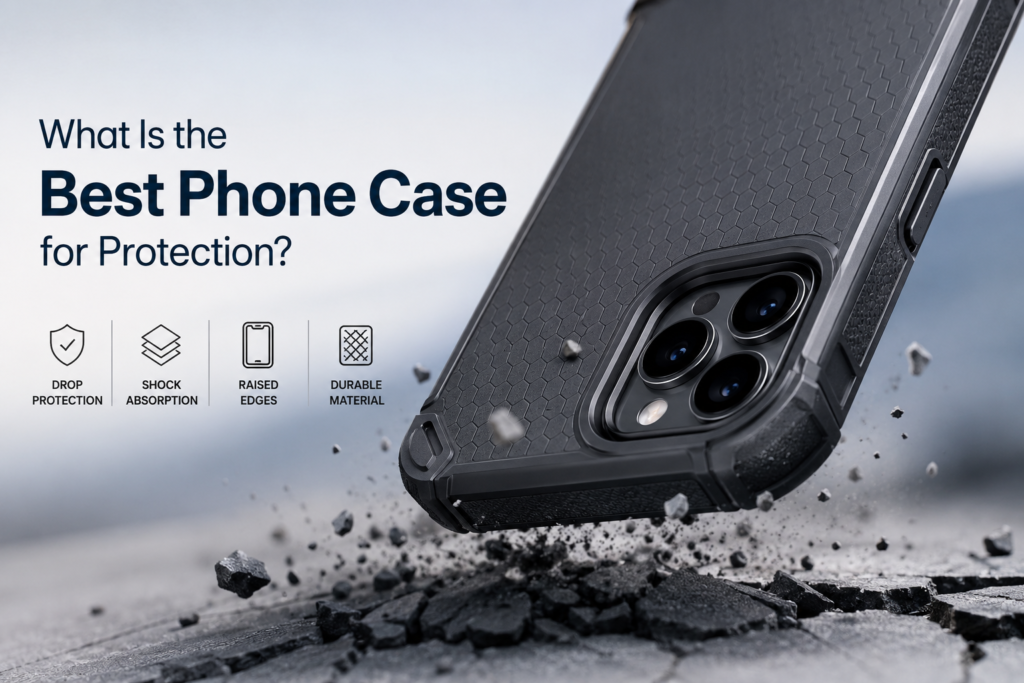
There is no single case that is best for everyone. Anyone who tells you otherwise is selling something.
The right case depends on two things. How far your phone usually falls. And how much thickness you can live with.
This guide uses lab standards and independent drop test results, not brand claims. By the end you will know exactly what to check before you buy.
Most articles about the best phone case for protection just list expensive brands. This one shows you the four physical features that decide whether your screen survives.
Quick Answer
- Everyday drops from a pocket or table: a dual layer case with raised edges is enough.
- Job sites, farms, and outdoor work: a full rugged case with port covers is safer.
- You hate bulk: pick a slim case with reinforced corners and a deep screen lip.
- Kids use your phone: a full body case with a built in screen cover.
One finding surprises most buyers. Thickness does not equal safety. Corner design and the gap above your screen matter more than how big the case is.
Quick Pick Table
| Your situation | What to look for | Why it works |
|---|---|---|
| Office, school, commuting | Dual layer case, raised lip | Handles waist height falls |
| Construction, farm, outdoors | Full rugged, port covers | Blocks dust and rain too |
| Small pockets, hate bulk | Slim case, strong corners | Protection without thickness |
| Kids or frequent droppers | Full body with screen cover | Survives repeat impacts |
| Cycling, hiking, driving | Case with a mount system | Phone is held, not carried |
| You want looks and safety | Printed shockproof case | Same build, better design |
Why This Choice Costs Real Money
A phone case looks like a small purchase. The repair bill behind it is not small.
Apple charges roughly $149 to $379 for an out of warranty screen service, depending on the model. Back glass repair is billed separately, usually $149 to $199. Independent shops charge less, around $60 to $320, but part quality and warranty vary a lot.
Damage is also far more common than people expect. Allstate Protection Plans runs a study called Mobile Mythconceptions. In one of its surveys, 78 million Americans reported damaging a device within a single year. Cracked screens topped the list. The average repair or replacement cost came out at $302.
Here is the number that matters most for this guide. About 80 percent of owners already keep their phone in a case. Even so, 21 percent said they dropped and damaged a phone while it was in one.
So a case is not a magic shield. The way the case is built decides the outcome.
What Military Grade Really Means
Almost every brand uses this phrase. Very few explain it.
It points to MIL-STD-810, a United States Department of Defense test standard. The drop portion sits under Method 516, Procedure IV, known as the transit drop.
In plain words, the test works like this:
- The item is dropped 26 times in total.
- Drops cover all 6 faces, 12 edges, and 8 corners.
- Drop height is 48 inches. That is 4 feet, or about 1.2 metres.
- The older 810G version used plywood over concrete. The newer 810H version uses steel over concrete, which is a much harder surface.
The part brands leave out
The 26 drops can be split across five test samples. No single case has to survive all 26. A brand can pass the test while each sample takes only five or six hits.
There is also no referee. No independent body verifies these claims. You are trusting the maker to report its own results honestly.
So how do you tell a real claim from a marketing line? Look for specifics.
A brand that states the method, the drop count, the height, and the sample count is giving you something you can check. A brand that says only “military grade protection” is giving you a feeling.
Ask three questions before you trust the label:
- Which version was used, 810G or 810H?
- One sample or five?
- Which impact surface, plywood or steel?
What Independent Drop Tests Actually Found
Marketing claims are one thing. Testing is another.
In 2026 the YouTube channel Project Farm ran a large case comparison and destroyed a $1,300 phone doing it. The lineup included OtterBox, Mous, ESR, Rokform, Spigen, dbrand, Caudabe, Torras, Ridge, and several budget brands.
The results did not match the brand rankings most buyers expect.
Corner drops at 24 inches
- The bare phone was destroyed.
- OtterBox kept the glass intact, but the phone took more damage than ESR and Ridge.
- Caudabe performed better than OtterBox.
- Rokform survived with very little damage.
Corner drops at 30 inches
- OtterBox struggled and its corner folded.
- Rokform showed no visible damage to the phone.
- Mous took only a small corner dent and beat most of the field.
Pushed to 36 and 42 inches
ESR and Rokform were the last two standing. ESR showed slightly less damage at 42 inches and finished as the overall winner for drop protection.
Screen buffer, the most overlooked number
Screen buffer is the gap between your glass and the ground when the phone lands flat on its face. The tester measured it across the field. The spread was enormous.
| Case | Screen buffer |
|---|---|
| ESR | 1.52 mm |
| MKK | 0.93 mm |
| Ornato | 0.66 mm |
| Tocol | 0.39 mm |
| Myrica | 0.36 mm |
| Spigen | 0.25 mm |
| Supfine | 0.18 mm |
| Apple | 0.12 mm |
| Ridge | 0.12 mm |
| FNT Case | 0 mm |
A case with a 0 mm buffer gives your screen nothing at all on a flat face down drop.
The takeaway is simple. The most famous brand is not automatically the safest one. And a single claim on the box tells you very little.
The Five Things That Actually Decide Protection
Skip the marketing. These five details do the real work.
1. Corner design
Most drops land on a corner. A corner is a tiny point taking the full force of the fall.
Good cases build extra material there. Spigen calls its version Air Cushion. Other brands use hollow pockets or thicker walls. The idea is the same. Give the impact somewhere to go before it reaches your phone frame.
Pick up any case and squeeze the corners first. If they feel the same as the sides, the case is weakest exactly where it will land.
2. Screen gap
Lay the case face down on a table and look at the edge from the side.
If the screen sits level with the case lip, your glass will meet the ground on a face down fall. If the lip stands proud by a millimetre or more, the case takes the hit instead.
As the test numbers above show, this gap ranges from nothing to over 1.5 mm. It is one of the cheapest features to build and one of the most commonly skipped.
3. Material layers
Three materials do most of the work.
- TPU: soft and rubbery. It absorbs shock well and grips your hand. On its own it flexes too much.
- Polycarbonate: a hard plastic. It spreads force across a wide area. On its own it cracks.
- Aramid fibre: the material used in body armour. Very strong for its weight. Mous uses it to reach high protection in a slim shell.
The best builds combine them. A soft inner layer soaks up the hit. A hard outer shell spreads it out. This is exactly why a well made slim case can beat a thick case made from a single material.
4. Grip
This one gets ignored, and it prevents more damage than anything else on the list.
A case you can hold stops the fall before it starts. Textured sides, finger grooves, and a matte finish all help. Glossy plastic and smooth glass backs do the opposite.
Think of it this way. Armour helps after the drop. Grip means there is no drop.
5. Fit
A loose case shifts on impact. That lets the phone frame reach the ground anyway.
Cutouts matter too. A camera ring that sits level with the lenses is not protecting them. Look for a raised rim around the camera. Rear glass and camera glass are expensive, and back glass repair is often billed on top of the screen.
Case Types Explained Simply
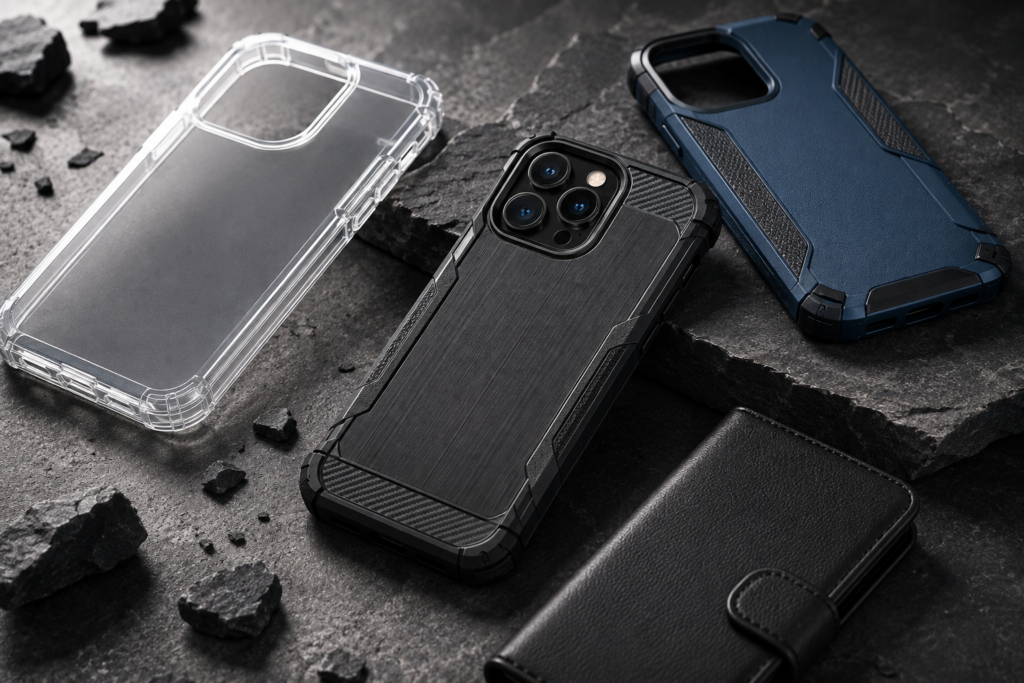
| Type | Protection | Bulk | Best for |
|---|---|---|---|
| Slim or clear | Low to medium | Very low | Careful users, style first |
| Dual layer | Medium to high | Medium | Most people |
| Rugged | High | High | Trades and outdoor work |
| Full body | Highest | Highest | Kids, repeat droppers |
| Wallet or folio | Medium | Medium to high | Carrying cards |
| Waterproof pouch | Water only | Low | Beach, pool, boats |
A quick note on full body cases. They include a built in screen cover. That shields your glass, but the film can scratch over time and can dull touch response. Many users prefer a separate tempered glass protector instead.
What About Water and Dust Ratings?
Most modern phones already carry an IP rating of their own. IP68 means dust tight and protected against being submerged.
Here is what people miss. A drop can break that seal. Once the frame bends or the back glass cracks, the water resistance your phone shipped with is gone. Apple and Samsung both treat liquid damage as separate from normal warranty cover.
So impact protection is also water protection, indirectly. If you spend time near a pool, a lake, or a boat, a sealed pouch is the only real answer. A standard case is not waterproof, no matter how thick it is.
The Bulk Tradeoff, Told Honestly
Here is the trap. People buy the thickest case they can find, hate carrying it, and stop using it within a month.
A case sitting in a drawer protects nothing.
Be honest about your day:
- Slim jeans and a desk job? A medium case you actually keep on beats a rugged case you abandon.
- Work boots and a tool belt? Go rugged and accept the size.
- Bike or hike often? Look for a case with a mount system so the phone is held rather than pocketed.
The best case is the one that stays on the phone.
Cold Weather Changes How Cases Behave
This matters if you live in Canada or the northern United States.
TPU stiffens as the temperature drops. A soft case that flexes nicely in July becomes noticeably harder in a Canadian January. Harder material absorbs less shock.
Two practical effects follow:
- A winter drop is often worse than a summer drop with the same case.
- Cheap thin TPU can turn cloudy or crack after repeated freezing.
If you live somewhere cold, choose a case with a hard outer shell plus a soft inner layer rather than a single soft shell. The layered build keeps working across a wider temperature range.
Grip matters more in winter too. Gloves reduce feel, and cold fingers fumble. A textured case earns its place in the months when you need it most.
Do You Still Need a Screen Protector?
Usually yes, but not for the reason most people assume.
A raised case lip protects your screen from flat drops. It does nothing against a stone, a key, or grit sitting in your pocket.
Tempered glass handles scratches and absorbs small impacts. It is far cheaper to replace than a display assembly.
One caution. Survey data shows plenty of people cracked screens while a protector was fitted. A protector reduces damage. It does not remove risk. Treat it as one layer in a set, not a guarantee.
Protection and Style Are Not Opposites
There is an old idea that you must choose. Either a plain black brick that survives anything, or a good looking case that shatters.
That was true ten years ago. It is not true now.
Modern shockproof builds use the same layered structure whatever is printed on the back. A dual layer shell with reinforced corners and a raised lip behaves the same way in plain black as it does with a full print. The protection lives in the structure. The design lives on the surface.
At Smart Case Design we build our shockproof range on exactly that principle. You should not have to trade safety for something you actually want to look at every day.
The practical point applies no matter where you buy. Judge the build, not the picture. Check the corners, check the lip, check the grip. Then pick the design you like.
Six Mistakes That Cost People Money
- Buying on brand name alone. Independent testing shows famous does not always mean safest.
- Trusting the military grade label without detail. Ask which version, how many samples, and which surface.
- Ignoring the camera rim. Rear camera glass is expensive and often left uncovered.
- Choosing thickness over corner design. A thick flat case can lose to a slim case with built up corners.
- Picking a slippery case. Grip prevents drops. Armour only reacts to them.
- Keeping a worn case too long. TPU yellows, softens, and loses shock absorption over time.
Frequently Asked Questions
What phone case is the most protective?
Full rugged cases with port covers and a built in screen cover lead the category, and OtterBox Defender is the best known example. In independent drop testing, Rokform, Mous, and ESR also performed very strongly, with ESR winning overall on drop results.
What is the most protective type of case?
A full body dual layer case. It pairs a soft inner shell that absorbs shock with a hard outer shell that spreads force, plus a raised screen lip and a protective camera rim.
What is the best phone case for someone who always drops their phone?
Look for three things together: reinforced corners, a screen lip of at least 1 mm, and a grippy textured finish. Grip matters most, because it reduces how often a drop happens at all.
Does military grade mean my phone cannot break?
No. It means the case passed a defined lab procedure. The standard allows the 26 drops to be spread across five samples, so no single case must survive all of them. Real drops also happen at heights and angles the test never covers.
Is a thicker case always safer?
No. Corner design, material layering, and screen gap matter more than raw thickness. Lab results show slim cases beating bulkier ones.
Do I still need a screen protector with a good case?
Usually yes. The case lip handles flat drops. The protector handles scratches, keys, and grit in your pocket.
Are printed or designer cases less protective?
Not by default. Protection comes from the case structure, not the artwork. Check the corners, the lip, and the materials, then choose the design you like.
How often should I replace my phone case?
Every one to two years with daily use. Replace it sooner if the corners look compressed, the TPU has yellowed, or the case feels loose on the phone.
Does a case protect the back glass and camera?
Only if it is built for it. Look for a raised camera rim and a back panel that covers the full rear surface. Back glass repair is charged separately from the screen and often costs $149 to $199.
The Bottom Line
Stop asking which brand is best. Start asking which build is right for your life.
Check four things on any case before you buy:
- Are the corners thicker than the sides?
- Does the lip stand above the screen when you lay it face down?
- Are there two materials, soft inside and hard outside?
- Can you grip it easily with dry hands?
If the answer is yes to all four, you have a genuinely protective case. What is printed on the back is your choice, not a compromise.
Browse the Smart Case Design shockproof range to find a case that protects properly and still looks like something you chose.