
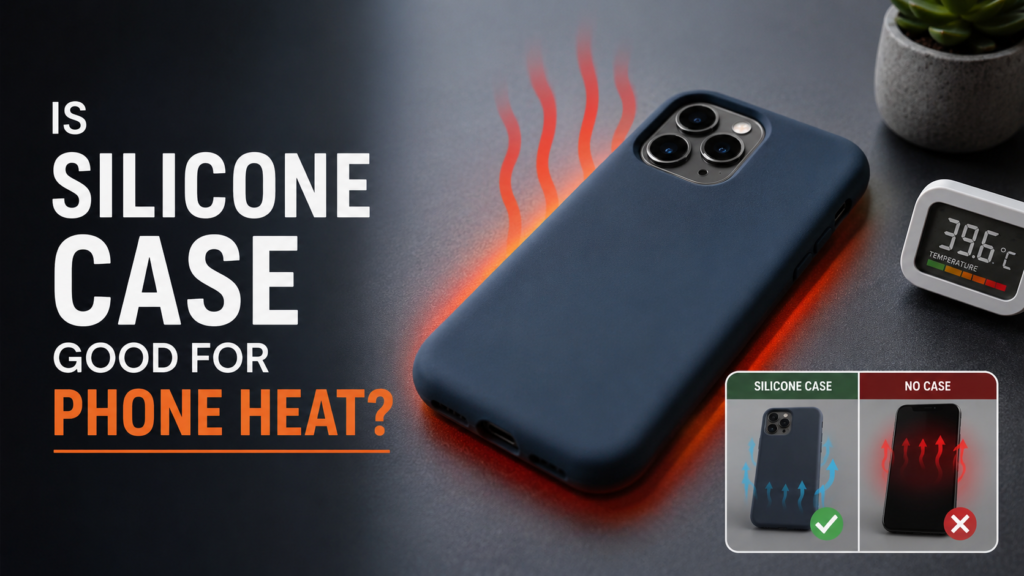
Silicone is average. Not good, not bad.
It holds heat about the same as TPU, about the same as polycarbonate, and slightly less than leather or wood. Every soft case material sits in a narrow band. The gaps between them are tiny.
What actually makes your phone hot is how thick the case is, and what you do with the phone while wearing it.
Here is the data, and here is why so many websites tell you something different.
Quick Answer
• Silicone does trap some heat. So does every other case material.
• Silicone is not the worst. Leather and wood hold heat slightly more.
• A thin silicone case beats a thick case of any material.
• Taking the case off while fast charging helps far more than switching material.
If you use your phone normally, a silicone case will not overheat it. If you game for hours or fast charge in the sun, any case will make things worse.
The Numbers Nobody Shows You
Thermal conductivity measures how fast a material moves heat. Higher means heat escapes faster. The unit is watts per metre kelvin.
| Material | Thermal conductivity | Better or worse than silicone |
| Aluminium (phone frame) | About 215 | Far better |
| Glass (phone back) | About 1.0 | Better |
| TPU | 0.15 to 0.25 | About the same |
| Silicone | About 0.2 | Baseline |
| Polycarbonate | 0.19 to 0.22 | About the same |
| Wood | 0.05 to 0.2 | Same or worse |
| Leather | About 0.14 | Worse |
Look at the top two rows first. Your phone frame moves heat about a thousand times better than any case material. The glass back moves it about five times better.
Now look at the case materials. They are all clustered between 0.14 and 0.25. Silicone sits in the middle. The difference between silicone and TPU is smaller than the difference between two silicone cases of different thickness.
That single fact answers the question. Material is not the variable that matters most.
Why Everyone Tells You to Avoid Silicone
Search this question and you will find plenty of advice. Read closely and a pattern appears.
A brand that sells wood cases will tell you wood runs cooler than silicone. A brand that sells leather will tell you leather breathes and silicone does not. A brand that sells hard plastic and TPU hybrids will tell you those beat silicone.
Each one is describing the material it happens to sell.
Now check those claims against the table above. Wood measures the same as silicone or lower. Leather measures lower. TPU overlaps silicone almost exactly. None of these materials is meaningfully cooler.
The idea that leather or wood breathes is the weakest claim of the group. A case sits flat against glass. There is no airflow gap to breathe through, and the numbers show these natural materials conduct heat more slowly, not faster.
We sell printed cases, so treat our view with the same care. That is why every number here comes from published material data you can look up yourself, not from our own marketing.
Four Things That Matter More Than Material
1. Thickness
Heat has to travel through the case to escape. Double the thickness and you roughly double the resistance.
A 1 mm silicone skin and a 3 mm rugged case are made of similar stuff. The rugged case will run hotter, because there is three times more material in the way. Many rugged cases also add air pockets in the corners, and trapped air is one of the best insulators there is.
So a thin silicone case will beat a thick wood or leather case every time, even though wood and leather sound more natural.
2. Charging with the case on
This is the big one.
Charging makes heat inside the battery. Fast chargers push 20 W, 30 W or more through a cell the size of a playing card. Wireless charging is worse, because it wastes more energy as heat and the charging pad sits flat against the back, blocking the main escape route.
Taking the case off during a fast charge does more for your phone temperature than any material swap.
3. Sunlight and colour
A dark case absorbs more sunlight than a light one. A black silicone case on a car dashboard in summer is the worst case scenario for any phone.
This is a real effect and it is bigger than the material gap. If you are outdoors a lot, colour choice beats material choice.
4. What you are doing
Texting and browsing produce very little heat. Your case will never be the problem.
Long gaming sessions, 4K video recording, video calls, live streaming and navigation with the screen bright all push the processor hard. That is when a thick case starts to matter.
Why Heat Is Worth Caring About
Heat is not just uncomfortable. It permanently shortens battery life.
Battery University, the reference source maintained by Cadex Electronics, publishes the numbers. Lithium batteries last longest at around 20 degrees Celsius. Run one at 30 degrees instead and cycle life drops by about 20 percent. At 40 degrees the loss is around 40 percent. At 45 degrees you are down to roughly half. You can read the full breakdown at Battery University.
Storage tests tell the same story. A fully charged cell kept at 25 degrees for a year keeps about 80 percent of its capacity. Kept at 40 degrees, that drops to about 65 percent.
So the goal is not to avoid every warm moment. It is to avoid long stretches of high heat, especially while charging.
Apple publishes a comfort zone for its phones too. iPhones are designed to be used in ambient temperatures between 0 and 35 degrees Celsius, which is 32 to 95 degrees Fahrenheit. Above that range you are outside what the phone was built for, case or no case.
When a Silicone Case Is Perfectly Fine
Most of the time. Specifically:
• Normal daily use, texting, calls, social media, music.
• Indoors, in an office, at school, at home.
• Slow overnight charging on a low power charger.
• Any time the case is thin and light coloured.
In these situations your phone barely warms up, and no case material is going to change the outcome.
When a Silicone Case Becomes a Problem
Silicone is not the cause here. Heat plus insulation is. But these are the moments to take the case off.
• Fast charging above 20 W.
• Wireless charging, especially on a pad rather than a stand.
• Long gaming sessions or recording video for more than a few minutes.
• Using navigation on a car mount in direct sun.
• Any time your phone shows a temperature warning.
If your phone throws a heat warning, remove the case first and move it into shade. That is the fastest way to bring the temperature down.
How to Tell If Heat Is Actually a Problem
Warm is normal. Hot is not. Watch for these signs:
• The screen dims on its own and will not brighten.
• Apps lag or games drop frames badly.
• The camera flash stops working or video recording quality drops.
• Charging slows down or pauses on its own.
• A temperature warning appears on screen.
These are signs of thermal throttling. Your phone is slowing itself down on purpose to cool off. It is a safety feature, not a fault.
One useful check: take the case off and repeat the same task. If the phone still gets very hot, the case was never the problem. Look at your battery health, your charger, or a background app instead.
Seven Ways to Keep Your Phone Cooler
1. Take the case off while fast charging. The single highest impact habit on this list.
2. Choose thin over thick. Thickness beats material, every time.
3. Pick a lighter colour if you are outdoors often. Dark cases soak up more sun.
4. Do not charge under a pillow or on a bed. Soft bedding traps heat far better than any case.
5. Drop the screen brightness during long sessions. The display is a major heat source.
6. Use a stand rather than a flat pad for wireless charging. A stand leaves more surface exposed to air.
7. Keep it out of direct sunlight. A dashboard in summer will beat any case design.
Choosing a Case If Heat Worries You
Skip the material argument. Judge these three things instead.
• How thick is it? Thinner is cooler. This matters more than anything else.
• How much of the phone does it cover? Open cutouts around ports and camera let some heat out. Full body cases with built in screen covers trap the most.
• What colour is it? Only matters outdoors, but outdoors it matters a lot.
You do not have to pick between protection and temperature either. A dual layer case with a hard shell and reinforced corners can be slimmer overall than a chunky single material case, and it protects better.
Our shockproof cases use that build. If you want to understand what actually makes a case protective, we broke down the drop test data in our guide to the best phone case for protection.
And if you want something thin with a design you actually like, you can design your own case and pick your exact phone model.
Frequently Asked Questions
Is silicone case good for phone heat, or should I switch material?
Silicone is average. It has a thermal conductivity of about 0.2 W/m K, which is very close to TPU at 0.15 to 0.25 and polycarbonate at 0.19 to 0.22, and slightly better than leather at about 0.14. All case materials insulate. Thickness and charging habits affect your phone temperature far more than which of these materials you pick.
Do silicone cases make phones overheat?
Not on their own. A silicone case slows heat escaping, but so does every case. Overheating comes from the processor, the battery or the sun. A case only makes an existing heat problem worse. In normal daily use a silicone case will not overheat a phone.
Is TPU better than silicone for heat?
Barely, and not reliably. Published figures put TPU at 0.15 to 0.25 W/m K and silicone at about 0.2. The ranges overlap, so a particular TPU case could be better or worse than a particular silicone case. Thickness is the bigger factor.
Do leather or wood cases run cooler than silicone?
No. Leather sits around 0.14 W/m K and wood ranges from about 0.05 to 0.2. Both are equal to or worse than silicone at moving heat away. Cases that sit flat against the phone have no airflow gap, so the idea that natural materials breathe does not hold up.
What is the coolest running phone case material?
Among common case materials, none is clearly best. Thin polycarbonate and aramid fibre do slightly better because they can be made very thin, not because the material is special. The coolest option of all is a bumper style case that leaves the back exposed.
Should I take my case off while charging?
Yes, for fast charging and wireless charging. Charging generates heat inside the battery, and heat is the main thing that shortens battery life. Removing the case during high power charging does more good than switching case material.
Does case colour affect phone temperature?
Yes, but only in direct sunlight. A dark case absorbs more solar energy than a light one. Indoors, colour makes no difference.
How hot is too hot for a phone?
Apple designs iPhones for ambient temperatures between 0 and 35 degrees Celsius, or 32 to 95 degrees Fahrenheit. Warm to the touch is normal. Screen dimming, heavy lag, paused charging or an on screen temperature warning mean the phone is too hot and needs to cool down.
Does heat really damage the battery?
Yes, and permanently. Battery University data shows lithium cells run at 30 degrees Celsius lose about 20 percent of cycle life compared to 20 degrees. At 40 degrees the loss is around 40 percent, and at 45 degrees it is roughly half.
Is a thin case really better than a thick one for heat?
Yes. Heat has to pass through the case to escape, so more material means more resistance. A thin case of any material will run cooler than a thick case, and thick rugged cases often add insulating air pockets on top.
The Bottom Line
Silicone is a fine choice. It is not the villain the internet makes it out to be.
Every case material insulates, and they all sit within a narrow band of each other. What separates a cool phone from a hot one is thickness, sunlight, and whether you leave the case on during a fast charge.
Pick a case that is thin enough for your life, take it off when you fast charge, and keep it out of the sun. Then choose whatever design you actually want to look at.